<?xml version="1.0" encoding="utf-8"?><feed xmlns="http://www.w3.org/2005/Atom" ><generator uri="https://jekyllrb.com/" version="4.4.1">Jekyll</generator><link href="https://thinkhuman.com/feed.xml" rel="self" type="application/atom+xml" /><link href="https://thinkhuman.com/" rel="alternate" type="text/html" /><updated>2026-01-01T16:52:39-08:00</updated><id>https://thinkhuman.com/feed.xml</id><title type="html">thinkhuman</title><subtitle>by James Gill</subtitle><author><name>James Gill</name></author><entry><title type="html">The Four Questions</title><link href="https://thinkhuman.com/the-four-questions/" rel="alternate" type="text/html" title="The Four Questions" /><published>2025-12-14T00:00:00-08:00</published><updated>2025-12-14T00:00:00-08:00</updated><id>https://thinkhuman.com/the-four-questions</id><content type="html" xml:base="https://thinkhuman.com/the-four-questions/"><![CDATA[<blockquote>
  <p>Love is the ultimate expression of the will to live.</p>

  <p>–Tom Wolfe</p>
</blockquote>

<p>(Note: A longer version of this story originally appeared in the December 2005 issue of <em>The NW Drizzle</em>, an online magazine.)</p>

<p>I never was much for Christmas.</p>

<p>When I was five, I was told Santa used the chimney to deliver presents. When I pointed out we didn’t have a chimmey, my mom, always a quick thinker, said Santa just used the front door. When I then pointed out that our door had three locks and we had two German shepherds, she just shrugged and said “he’s got a key”.</p>

<p>That’s when I knew Santa wasn’t real because in our house in the inner city, you didn’t give <em>anybody</em> keys to your house, especially a stranger who was going to come in at night and mess with stuff. I left him cookies and milk that year anyway.</p>

<p>When I found them the next morning, I knew that “Santa” hadn’t been able to get past the two deadbolts and lock. He’d passed me by, but somehow still got the presents under the tree. I knew I was being tricked.</p>

<p>When I was nine, we lived in a big, rambling old house down a long dirt road with a fireplace, a wood-burning kitchen stove, and a barn and outhouse out back. It sat near the edge of a hill that dropped steeply down to a creek. I loved it, except at night when it would get dark, that country dark where there are no street or city lights and you can’t see your hand in front of your face.</p>

<p>For our only Christmas there, we had almost no money, and all I could think of to give my mom was a flashlight, because she complained about going to
the outhouse at night. So, I went to Woolworth’s in Spencer and got a big, orange flashlight, and a painted plaster  picture of Jesus that cost fifty cents, spending all but 25 cents of my $4 budget.</p>

<p>Mom told me she loved the flashlight, and I was so excited about it that I made her open it on Christmas Eve. Soon I had to visit the outhouse, and of course, wanted to use the new flashlight. I pointed it all over as I walked the hundred feet or so, watching out for the ghosts that were well-known to inhabit the area, particularly around holidays.</p>

<p>I left the light on while I went about my business. As I was pulling up my pants, I saw the light suddenly flip towards the ceiling, then disappear. Looking down, I saw a glow coming from the one place in an outhouse you don’t want to see a glow coming from.</p>

<p>Sure enough, I’d knocked it in. <em>Way</em> in.</p>

<p>I don’t know what I was most afraid of; having to walk back to the house in the pitch black, or having to tell mom that her new orange flashlight was going to be illuminating our two-seater from the inside for a while. As I jogged back to the house, I reminded myself–at least she still had the painted plaster Jesus.</p>

<p>I’ve thought about that flashlight many times over the years. But mostly, I remember what it was like then to have almost nothing at all, and not feel poor. I made toys out of what I found, climbed trees, fought wars, found wild strawberries, and learned about the facts of life from a patient girl in a hayloft. Christmas was not a big deal, because I didn’t expect much; the tree and decorations were pretty amazing by themselves.</p>

<p>I heard the other day the average kid these days has about 1000 toys, if you count up all the parts. I think when I was nine I had three–a pocketknife, a Lincoln Log set, and a BB gun that never really worked. It always seemed best to be able to carry all your toys, so you could use them wherever you were. Having too many meant you had to leave some behind, and it was too hard to choose what to take.</p>

<p>The past few years, as I go through this mid-life crisis of simplifying life, getting rid of all the things I’ve accumulated–the toys, excess clothes, computer junk, gadgets, unused furniture, unread books, old magazines–I realize that all I really want is a pocketknife. And my Lincoln Log set. And in place of the BB gun, maybe my guitar.</p>

<p>But one final Christmas thought.</p>

<p>I saw a movie last week. Maybe you’ve heard of it–<em>Don Juan de Marco</em>. The plot isn’t important, or even the ending. Don Juan, the self-styled “greatest lover in the world,” grows tired of the questions his interviewer keeps asking, and so sums things up for him:</p>

<blockquote>
  <p>“There are only four questions of value in life, Don Octavio:</p>

  <p>What is sacred? 
Of What is the spirit made? 
What is worth Living for? and 
What is worth Dying for?</p>

  <p>The answer to each is the same: only Love!”</p>
</blockquote>

<p>As simple as it sounds, I think he got it right.</p>]]></content><author><name>James Gill</name></author><summary type="html"><![CDATA[Love is the ultimate expression of the will to live. –Tom Wolfe]]></summary></entry><entry><title type="html">Chrome Bumpers</title><link href="https://thinkhuman.com/chrome-bumpers/" rel="alternate" type="text/html" title="Chrome Bumpers" /><published>2025-11-30T00:00:00-08:00</published><updated>2025-11-30T00:00:00-08:00</updated><id>https://thinkhuman.com/chrome-bumpers</id><content type="html" xml:base="https://thinkhuman.com/chrome-bumpers/"><![CDATA[<blockquote>
  <p>Technology doesn’t just do things for us. It does things to us, changing not just what we do but who we are.</p>

  <p>–Sherry Turkle</p>
</blockquote>

<p>In technology-filled schools around the world, there’s intense debate about student cell phone use and its impact on mental health and learning. So, many schools now limit or ban them altogether during the school day.</p>

<p>My daughter entered high school a few months ago. On the first day, she was sternly warned to lock her cell phone away in a ‘<a href="https://www.overyondr.com/phone-locking-pouch">Yondr pouch</a>’ where it couldn’t be accessed during the school day.</p>

<p>I’m old enough to remember classrooms devoid of computers and other devices. Calculators existed but were expensive, and few teachers allowed them since they were considered ‘cheating’. The most high-tech device was a slide projector. If you’re older like me, you probably remember the hum of the projector lamp and the <em>ka-chunk</em> of the slides changing. Discussions with the teacher happened in class, or just before or after. Teachers gave you written feedback on your assignment on paper or in person. And when I moved from middle school to high school, the biggest change was the venue; I had to learn my way around campus (and the teachers), but the paper, pencils, notebooks and textbooks were all familiar tools.</p>

<p>But for my teenage daughter who just started high school, it’s all different.</p>

<p>From Kindergarten through 8th grade, her school experience did not include technology. No laptops, phones, calculators, tablets, <em>anything</em>. She wrote and drew and did math and other subjects by hand, and was outside often. Students had written evaluations, but there were no letter grades. Throughout the year, students compiled a ‘main lesson book’ of all their meaningful work, and bound it themselves at the end of the year to take home. All by hand. In many ways, it resembled my own experience from decades before.</p>

<p>Despite this (or because of it), she arrived at a public high school well-prepared–except for the firehose of technology. She was immediately given a Chromebook, an email account, multiple software applications–and an expectation that she already knew how to use all of it to learn, communicate, and do her work.</p>

<p>My daughter had to immediately grapple with a stack of technological tools to communicate with teachers, learn assigment details, complete forms, read and post messages, and do work and turn it in. Chromebooks for everything. ‘Google Classroom’ for class assignments and communication (with both students and teachers) and watching deadlines. ‘StudentVue’ for information about grades, schedules, buses, course plans, student profiles. And more.</p>

<p>She was overwhelmed, of, course. Stressed out. Assignments and messages and laptop work came rapid-fire for <em>eight</em> different classes. Teachers posted note after note, videos to watch, lengthy instructions.</p>

<p>She was assigned a locker–but with only six minutes between classes, she never uses it. Need to use the bathroom, get water, go across campus to your class? No time to visit the locker. So, she (like most other kids) carries <em>everything</em> on her back–Chromebook, lunch, water bottle, books, anything she needs for the day. The lockers silently line the hallways, mostly unused.</p>

<p>In her classes, many students are veterans of all this. The ubiquity of technology in school and the backpack life is commonplace to them. But not her.</p>

<p>And so she carries, uses and wrestles with technology constantly for most of the school day–<strong>but not phones</strong>. Her phone sits quietly in a locked pouch in her backpack, singled out for exclusion.</p>

<p>My entire professional life has been about technology. I’m not a anti-technology, and know well the costs and benefits of it. But why do we ban cell phones in school for reasons of health and distraction, while ignoring the real impacts of all the <em>other</em> technology we foist upon children? My daughter saw through (and felt) this cognitive dissonance immediately; I’m sure many of the other kids do too.</p>

<p>I don’t buy the arguments of “they’re getting ready for the ‘real’ world”. Should school be a vocational practice of the ‘real’ world? Is that what it’s for?</p>

<p>I’m not an educator, but my wife is. She’s seen the slow creep of technology into classrooms, and from what I hear most teachers if given the chance would gladly collect the Chromebooks and put them in the dumpster.</p>

<p>I have a feeling that given the choice and the opportunity to experience a more ‘low tech’ education, kids might do the same.</p>

<p>I recently read a <a href="https://www.nytimes.com/interactive/2025/11/20/us/typewriter-repair-seattle-bremerton.html">story of a man</a> who decided to change careers late in life and start repairing and selling typewriters. Noticing the clientele who seemed most excited about his machines, he said:</p>

<p><em>“The kids get it. They’re not trying to be nostalgic for something they never experienced. They’re trying to escape what they experience every day.”</em></p>

<p>And I agree. I think the kids get it, and maybe its time we got it too.</p>

<blockquote>
  <p>Computers are useless. They can only give you answers.</p>

  <p>–Pablo Picasso</p>
</blockquote>]]></content><author><name>James Gill</name></author><summary type="html"><![CDATA[Technology doesn’t just do things for us. It does things to us, changing not just what we do but who we are. –Sherry Turkle]]></summary></entry><entry><title type="html">AI, AI…Oh</title><link href="https://thinkhuman.com/aiaioh/" rel="alternate" type="text/html" title="AI, AI…Oh" /><published>2025-11-12T00:00:00-08:00</published><updated>2025-11-12T00:00:00-08:00</updated><id>https://thinkhuman.com/aiaioh</id><content type="html" xml:base="https://thinkhuman.com/aiaioh/"><![CDATA[<blockquote>
  <p>Humanity is acquiring all the right technology for all the wrong reasons.</p>

  <p>–R. Buckminster Fuller</p>
</blockquote>

<p>“AI” is not doing anything.</p>

<p>AI is not taking your job. AI is not stealing your words or images or personal information. AI is not controlling your mind, or your life, or the decisions you make. AI isn’t looking to wipe out humanity. AI is not doing…anything.</p>

<p>Then what (or who) is?</p>

<p><em>People</em>. It’s just people. <em>People</em> made AI. <em>People</em> decide how to use it, where to use it, what to use it for, or whether to use it at all. It’s just…people. All the decisions and effects and consequences are the result of…choices and actions made by people.</p>

<p>Nothing about AI is inevitable. It’s just human choices. What you hear and see is just another inevitable cycle of capitalism as businesses trying to compete, get an edge, whatever. So what feels like breathless ‘progress’ is really just people wondering “how can I make a lot of money with this new thing?”.</p>]]></content><author><name>James Gill</name></author><summary type="html"><![CDATA[Humanity is acquiring all the right technology for all the wrong reasons. –R. Buckminster Fuller]]></summary></entry><entry><title type="html">Judgment Calls</title><link href="https://thinkhuman.com/judgment-calls/" rel="alternate" type="text/html" title="Judgment Calls" /><published>2025-10-23T00:00:00-07:00</published><updated>2025-10-23T00:00:00-07:00</updated><id>https://thinkhuman.com/judgment-calls</id><content type="html" xml:base="https://thinkhuman.com/judgment-calls/"><![CDATA[<blockquote>
  <p>Ethics is nothing else than reverence for life.</p>

  <p>–Albert Schweitzer</p>
</blockquote>

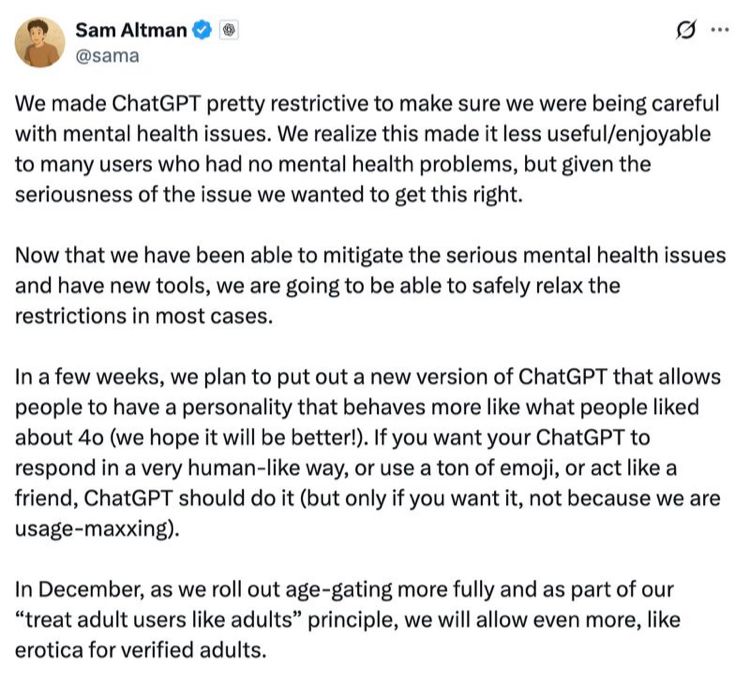
<p>Recently, I saw Sam Altman’s announcement that OpenAI’s ChatGPT will soon allow porn–or as Altman euphemistically called it, ‘erotica’.</p>

<p>Here’s Altman’s complete announcement:</p>

<p><img src="/assets/images/altman_erotica.jpeg" alt="" /></p>

<p>After the inevitable backlash, Altman said</p>

<blockquote>
  <p>“we are not the elected moral police of the world”</p>
</blockquote>

<p>and</p>

<blockquote>
  <p>“It was meant to be just one example of us allowing more user freedom for adults”.</p>
</blockquote>

<p>Still scrambling, he added later:</p>

<blockquote>
  <p>“Well, we haven’t put a sex bot avatar in ChatGPT yet”</p>
</blockquote>

<p>which was a dig at what Elon Musk has already done with his xAI.</p>

<p>I’m picking on OpenAI here, but only to illustrate a point.</p>

<p>To be clear: I’m not concerned about the availabity of ‘erotica’, whether created or…generated. I’m not even concerned about the difference between titillation and exploitation or even monetization, or which label fits OpenAI’s new feature.</p>

<p>What I <em>am</em> concerned about is an increasingly common view I hear from those working in tech, which goes something like: “My job is technical, not ethical.”</p>

<p>I see this everywhere now. Not just amongst the captains of tech industry like Musk, Altman, or Peter Thiel, but engineers, marketers, middle managers, everyone. Even my own coworkers.</p>

<p>You’ve probably seen this in other contexts, too: tobacco, guns, drugs and alcohol, you name it. It’s not limited to tech.</p>

<p>Hannah Arendt called this ‘<a href="https://en.wikipedia.org/wiki/Eichmann_in_Jerusalem">the banality of evil</a>’–moral disengagement through obedience or neutrality. It seems a straightforward attempt to avoid moral dilemmas by claiming it’s not your <em>job</em> to even <em>have</em> such dilemmas, to make moral or ethical judgments. Rather, your job is to give other people what they want and let <em>them</em> make those judgments. Like Altman, call it ‘freedom’ and be done with it.</p>

<p>But that ‘freedom’ coin always comes with a flip side: <em>responsibility</em>. And we humans don’t like to flip that coin over. Instead, we say “It’s just business”, or “guns don’t kill people, people do”, or more grim: “I was just following orders”.</p>

<p>Of course, <em>nobody’s</em> job (or life) is disconnected from ethics or morality; we all apply them (with varying degrees of consistency and success) to how we live and work.</p>

<p>I’m not talking about ‘corporate’ ethics or morality (whatever those are), but <em>personal</em>. Ultimately, these are <em>always</em> personal decisions. What do <em>you</em> believe is right or wrong? Where do <em>you</em> stand? Corporations don’t make those decisions: only people do, even if they obscure it behind a corporate veil.</p>

<p>So what <em>should</em> we do, how <em>should</em> we act?</p>

<p>First, let’s understand that tech is a different animal altogether: unlike tobacco or guns or alcohol, tech pervades every aspect of human life and can affect <a href="https://www.popularmechanics.com/space/satellites/a68967712/starlink-satellites-falling-from-the-sky/">the planet itself</a>, making it a domain where we need to pause and reflect <em>more</em> about the consequences of our actions.</p>

<p>Then, let’s set the bar higher: instead of starting with <em>why not?</em>, let’s start by asking <em><a href="https://thinkhuman.com/the-roots/">why</a>?</em> –and try to be sure we come up with a damn good answer.</p>

<blockquote>
  <p>When morality comes up against profit, it is seldom that profit loses.</p>

  <p>–Shirley Chisholm</p>
</blockquote>]]></content><author><name>James Gill</name></author><summary type="html"><![CDATA[Ethics is nothing else than reverence for life. –Albert Schweitzer]]></summary></entry><entry><title type="html">Dis-Incorporating</title><link href="https://thinkhuman.com/dis-incorporating/" rel="alternate" type="text/html" title="Dis-Incorporating" /><published>2025-10-15T00:00:00-07:00</published><updated>2025-10-15T00:00:00-07:00</updated><id>https://thinkhuman.com/dis-incorporating</id><content type="html" xml:base="https://thinkhuman.com/dis-incorporating/"><![CDATA[<blockquote>
  <p>For the past 33 years, I have looked in the mirror every morning and asked myself: ‘If today were the last day of my life, would I want to do what I am about to do today?’ And whenever the answer has been ‘No’ for too many days in a row, I know I need to change something.</p>

  <p>–Steve Jobs</p>
</blockquote>

<p>I’m leaving corporate life, or at least trying to. Let me tell you a story about why.</p>

<h2 id="how-i-got-here">How I Got Here</h2>

<p>I had my first professional ‘corporate’ job in the early 90s, while still in my twenties. I’d had jobs before that, of course; in college I worked in a warehouse, drove a cab, made deliveries, waited tables. I’d tried a few desk jobs, but they didn’t stick.</p>

<p>Then I accidentally discovered tech.</p>

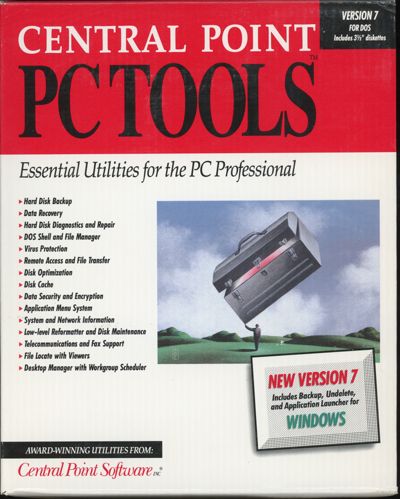
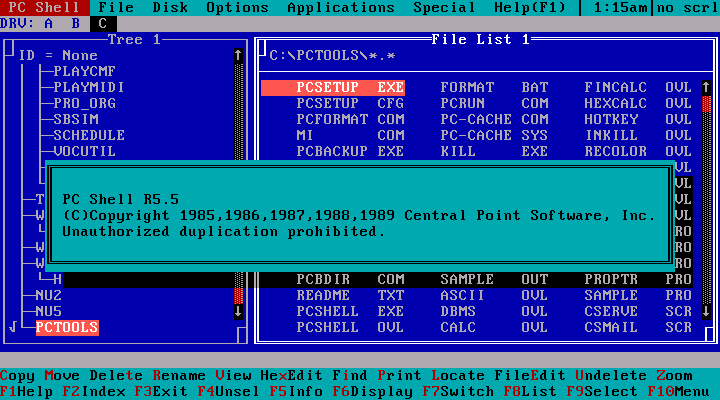
<p>That first ‘corporate’ job was testing a DOS (!) software suite called PC Tools, for a company named Central Point Software. I worked on the one pictured below. Remember when software came in boxes?</p>

<p><img src="/assets/images/pctools.jpg" alt="PC Tools" /></p>

<p><img src="/assets/images/pctoolsui.png" alt="PC Tools" /></p>

<p>Because I had some skill with French and German, I was hired to go through the interface and proofread internationalized versions for language errors. I commuted to work, sat in a cubicle near people like me, and was mostly left to my own devices. It was fantastic–the money was easy and plentiful, there was free food, a collegial atmosphere, and I got to work with smart and quirky people making useful things. It tickled the hazy science and technology dreams of my youth. <em>This is it</em>, I thought. <em>This is the life I want.</em></p>

<p>Though that job was short term, I was in the right place at the right time–tech was booming in the 90s, and jobs seemed to be everywhere. I quickly found a job in technical writing–based largely on the CPS job, my writing skills, and having spent the first few years of college studying electrical engineering. In short–I told a good story about myself, and they bought it. They needed people.</p>

<p>Things <em>really</em> took off after that. What followed was many years of (mainly tech) jobs–filled with commutes, cubicles, great money, and the excitement of working with technology. <em>This is it</em>, I thought. <em>This is the life I want</em>.</p>

<p>People I knew who <em>weren’t</em> in tech were amazed. It was like I lived in a different world. And I suppose I did, but I often felt like an outsider, a pretender. Despite all the comforts and benefits, something felt off. <em>This is it right?</em> I thought. <em>The life I want?</em></p>

<p>The pattern repeated for years. Startup, layoff. Grad school detour, back to tech. Environmental consulting, another layoff. More tech jobs. Each time I told myself it would be different. Each time I felt like I was living someone else’s life.</p>

<p>In a fit of frustration, I wrote a short book about breaking into technical writing. It did well - better than I expected. I was thrilled. I made plans to write more.</p>

<p>But I didn’t. I was scared, and I needed more money. By then I was married with a young daughter, and the luxury of soul-searching was gone. I needed stability, insurance, and a paycheck that showed up every two weeks.</p>

<p>So I took a job at a large health care company and told myself I’d make it work. And for a while, I did. Eight years, in fact.</p>

<p>But somewhere along the way, the pattern I’d been running from caught up with me again.</p>

<p>Eventually, the commutes felt longer. The cubicles felt more gray and cramped. Though I became a remote worker, I spent more and more time in meetings that could have been emails, and emails that could have been nothing. I worked around layers of bureaucracy, heard “that’s how we do it” so many times it became background noise.</p>

<p>Most days I wasn’t doing work - I was “doing corporate.” Navigating organizational theater. Protecting territory. Justifying decisions that had already been made. Explaining things to people who weren’t really listening.</p>

<p>I began to feel empty again. Like I was going through the motions of what I was <em>supposed</em> to be doing, not what <em>mattered</em>. I felt like a fraud, and I resented it. But mostly I resented myself for accepting it–again.</p>

<p>Today, I’m in the “60+” age category. I have no idea where the time went. To be blunt–I have less time to waste on bullshit. I have resources, but time is no longer a luxury. Now, I think I realize what I struggled throughout my career to be clear about.</p>

<p>Without my realizing it, corporate life had shaped me. “I’m a Senior IT Consultant”, I would say, as if I was a job title. The language I used: <em>synergize</em>, <em>operationalize</em>, <em>bandwidth</em>, <em>circle back</em>, <em>move the needle</em>, <em>actionable</em>, <em>drill down</em>, <em>strategic alignment</em>, <em>take it offline</em>. Words that sounded important but meant nothing.</p>

<p>I spent years being valuable in ways that didn’t fit job descriptions. Connecting dots others missed. Explaining complex things clearly. Seeing the human problem underneath the technical one. But corporate life rewards specialists with credentials and titles, not generalists who see connections.</p>

<p>I’d been optimizing for the wrong things. And I was running out of time to fix it.</p>

<p>It’s not just “meetings are annoying” but the deeper waste - the sheer amount of energy that goes into navigating the organization vs. actually solving problems. Corporate life often forces you to serve the process instead of using it to serve humans.</p>

<hr />
<p>And so: I’m leaving corporate life, or trying to.</p>

<p>It’s not because I don’t want to work, but because I can’t afford to spend what time I have left navigating organizational theater instead of solving real problems. I’m trying to build a life where my work liberates people instead of just optimizing processes—and I’m figuring it out as I go.</p>

<p>I’m scared, to be honest. Scared I’m too old to start over, or that my runway will run out before I figure this out. Scared I’ll end up back in some corporate job because I couldn’t make anything else work.</p>

<p>But I’m more scared of looking back at 70 or 80 and realizing I spent my last good years serving organizational theater instead of helping people.</p>

<h2 id="whats-next">What’s Next</h2>

<p>This isn’t ‘early retirement’, or ‘I made my money and now I’m free’. Far from it. I’m not anti-work, either. I just want to spend my time creating things that matter.</p>

<p>And I’m not leaving technology. I still love making things, solving problems, understanding how technology shapes our lives. Also, there’s a significant gap between the life I want and the life I need. I’m trying to bridge it without compromising back into what I just left.</p>

<p><strong>Where am I today?</strong></p>

<p>I’m trying to be visible again after months of being quiet. I’m looking for work that pays bills without draining my soul. I’m writing to figure this out as I go.</p>

<p>I don’t know what comes next exactly, but I know what I’m NOT doing anymore. Meanwhile, I’ll keep writing about what I’m learning. You’re welcome to follow along.</p>

<blockquote>
  <p>Just be honest with yourself. That opens the door.</p>

  <p>–Vernon Howard</p>
</blockquote>]]></content><author><name>James Gill</name></author><summary type="html"><![CDATA[For the past 33 years, I have looked in the mirror every morning and asked myself: ‘If today were the last day of my life, would I want to do what I am about to do today?’ And whenever the answer has been ‘No’ for too many days in a row, I know I need to change something. –Steve Jobs]]></summary></entry><entry><title type="html">Leaving Twitter</title><link href="https://thinkhuman.com/leaving-twitter/" rel="alternate" type="text/html" title="Leaving Twitter" /><published>2025-09-14T00:00:00-07:00</published><updated>2025-09-14T00:00:00-07:00</updated><id>https://thinkhuman.com/leaving-twitter</id><content type="html" xml:base="https://thinkhuman.com/leaving-twitter/"><![CDATA[<blockquote>
  <p><em>A baby is a loud noise at one end and no sense of responsibility at the other.<br />
—Ronald Knox</em></p>
</blockquote>

<p>Friends,</p>

<p>Sometimes, taking a small step can mean to <em>stop</em> doing something.</p>

<p>In late November (2024), amidst the noise of US elections and a growing sense of unease about social media, I closed my X (Twitter) account. You can’t ‘delete’ your account—X doesn’t allow that—but I deleted most of my posts and comments, deleted the app from all devices, and rendered the account inactive. I haven’t looked back.</p>

<p>Afterward, I felt an immediate sense of relief, like there was suddenly more…space around me. More calm. And I soon saw just how unimportant it all was, how little value it held, how ‘noisy’ it was. When I check news websites like CNN, it confirms what I already knew—a 24/7 stream of noise added nothing to my life, but instead made me more anxious, more stressed out, and less present in my own life and to everyone around me.</p>

<p>I find the concept of a <a href="https://en.wikipedia.org/wiki/Signal-to-noise_ratio">‘signal to noise’ ratio</a> useful and apply it in many parts of my life. Like a radio, most of what you encounter on social media is static, but buried in the noise are signals. If you know the frequency, you can skip the noise and get the signal; if you don’t, you mostly hear noise while you search.</p>

<p>But social media—Twitter, Facebook, Instagram, TikTok, LinkedIn, all of it—is by design mostly <em>noise</em>. Random opinions, arguments, screeds, pornography, sales pitches, ads, public manifestos, outrage. Provocative stimulus to keep you clicking. And that noise is often the point: to get your attention, guide you into a sales funnel, or just manipulate your emotions.</p>

<p>For me, it’s not that social media doesn’t have any signal—it does—but once you’ve opened social media, it’s a full-volume blast that’s hard to calmly control and navigate.</p>

<p>And so I’ve come to realize that the only real way I can limit (or avoid) the noise is to avoid it altogether. And that means not participating at all.</p>

<blockquote>
  <p><em>I am losing precious days. I am degenerating into a machine for making money. I am learning nothing in this trivial world of men. I must break away and get out into the mountains to learn the news.<br />
—John Muir</em></p>
</blockquote>]]></content><author><name>James Gill</name></author><summary type="html"><![CDATA[A baby is a loud noise at one end and no sense of responsibility at the other. —Ronald Knox]]></summary></entry><entry><title type="html">General Specialist</title><link href="https://thinkhuman.com/general-specialist/" rel="alternate" type="text/html" title="General Specialist" /><published>2025-09-12T00:00:00-07:00</published><updated>2025-09-12T00:00:00-07:00</updated><id>https://thinkhuman.com/general-specialist</id><content type="html" xml:base="https://thinkhuman.com/general-specialist/"><![CDATA[<blockquote>
  <p>The future masters of technology will have to be light-hearted and intelligent. The machine easily masters the grim and the dumb.</p>

  <p>–Marshall McLuhan, 1967</p>
</blockquote>

<p>In IT, like most tech domains, there’s an obsessive focus on specialization.</p>

<p>And so, résumés (and careers) inevitably reflect that specialization: bulleted lists of popular technologies. Certifications, languages, industry-specific software tools. Buzzwords, acronyms, credentials. Years (or decades) spent proudly focused one or two technologies or vendors.</p>

<p>But that obsessive focus, and the people it shapes, are often what creates the technologies we love to hate. The processes that frustrate and discourage us; the painful, technology-driven solutions that create as many human problems as they solve; the privacy-exploiting products that ignore human problems altogether and exist solely to turn the *humans* into the product.</p>

<p>Here’s a simple example: HR systems used to screen applicants are infamously painful and overly complex, often requiring actions like the painstaking retyping of a resume after uploading one. Why is that? Because it’s a technology-driven solution, not a human problem-driven one. The humans experience comes last, in service to the technology.</p>

<p>I’ve spent most of my professional life as what you’d call a ‘generalist’—or as an old acquaintance once called it, a ‘General Specialist’. I didn’t plan it that way; when I first went to college I spent about two years studying electrical engineering, determined to become an expert in power generation so I could invent a limitless power source. But–I cared less about the movement of electrons and elegantly designed logic than I did about how people might live and create with that power source. The point seemed to be an elegant human life, not the machine.</p>

<p>I usually tell people that the work that interests me most is where humans and technology come together. Sure, I can write SQL queries, implement Agile, manage a backlog, draft a SWOT analysis, explain HIPAA privacy constraints, all those things–but they’re just means to an end. Mere tools. They’re things I could train anyone to start doing in a short amount of time.</p>

<p>I don’t mean to minimize technical expertise or domain knowledge or professional training. I have all those things, too. They have value and a place. But they aren’t the *point* of technology or technology jobs; they’re just tools.</p>

<p>Saying all this in a job interview, though, has gotten me everything from puzzled stares to outright anger (“okay, but have you saved money by making processes more efficient? Have you facilitated innovation? Do you have Agile experience?”).</p>

<p>But people who can focus on the big picture, see the humans, connect problems and ideas and choose tools and make meaningful decisions in ways that make the human experiences better? There are no certifications for that. No degrees, credentials, bleeding edge technologies, nothing. And they’re the people we need most in a world where technology is part of almost every aspect of human life.</p>]]></content><author><name>James Gill</name></author><summary type="html"><![CDATA[The future masters of technology will have to be light-hearted and intelligent. The machine easily masters the grim and the dumb. –Marshall McLuhan, 1967]]></summary></entry><entry><title type="html">Don’t Worry About College Majors</title><link href="https://thinkhuman.com/dont-worry-about-college-majors/" rel="alternate" type="text/html" title="Don’t Worry About College Majors" /><published>2025-09-11T00:00:00-07:00</published><updated>2025-09-11T00:00:00-07:00</updated><id>https://thinkhuman.com/dont-worry-about-college-majors</id><content type="html" xml:base="https://thinkhuman.com/dont-worry-about-college-majors/"><![CDATA[<p>I’ve heard a lot recently about ‘picking the right college major’. It’s normal to worry about such things. I remember.</p>

<p>But I think obsessing over picking the ‘right’ college degree is a waste of time. If you have particular interests, follow them in college, but waste no more time worrying if you’ve made the ‘right’ choice.</p>

<p>I’m in my 50s. I’ve heard hundreds of stories of the twists and turns of lives and the role of college in them–including my own. I was dead set on being an electrical engineer, and the first year and a half of college was in that subject. I was certain I was destined to invent the next power source and change the world with it.</p>

<p>I ended up with an undergrad in history, and (years later) a graduate degree in urban planning. I’ve been in the ‘tech’ business for 30-odd years as a technical writer, then usability engineer, then software developer, then analyst/product owner/whatever.</p>

<p>The best software engineer I know has an undergrad in fine arts. They own three software patents; they also make pottery.</p>

<p>My ‘old guy’ advice to those staring down college decisions:</p>

<p>The road doesn’t matter very much. Taking steps matters. Just keep taking action and learning and adjusting and, for god’s sake, enjoy your life. It’s a dance, <a href="https://www.youtube.com/watch?v=ERbvKrH-GC4">not a long march towards eventual happiness.</a></p>]]></content><author><name>James Gill</name></author><summary type="html"><![CDATA[I’ve heard a lot recently about ‘picking the right college major’. It’s normal to worry about such things. I remember.]]></summary></entry><entry><title type="html">Gentrification’s Wheel</title><link href="https://thinkhuman.com/gentrifications-wheel/" rel="alternate" type="text/html" title="Gentrification’s Wheel" /><published>2025-09-11T00:00:00-07:00</published><updated>2025-09-11T00:00:00-07:00</updated><id>https://thinkhuman.com/gentrifications-wheel</id><content type="html" xml:base="https://thinkhuman.com/gentrifications-wheel/"><![CDATA[<p>Gentrification is complex. Many say it’s better than the alternative. In many American cities, “blighted” areas are redeveloped or otherwise transformed, often with significant help from local government. Rarely do citizens spontaneously change the makeup of a neighborhood; it’s an act imposed from outside, using money and (sometimes) good intentions.</p>

<p>And gentrification isn’t always about blight: The <a href="https://en.wikipedia.org/wiki/Rue_des_Rosiers">Rue des Rosiers</a>, a <a href="http://www.cnn.com/2008/TRAVEL/getaways/06/04/jewish.quarter.ap/index.html">centuries-old Jewish neighborhood in Paris</a> (and by centuries-old, I mean since the Middle Ages), is undergoing the slow, inexorable crush of gentrification. Here’s an example of how gentrification, driven by the profit motive and executed with tools like tourism and hyper-consumerism, trashes a centuries-old ethnic neighborhood in a matter of a few years:</p>

<blockquote>
  <p>The district has been losing a vital chunk of its Jewish character to high-end designer labels in a slow transformation that residents say is reaching a turning point. Local officials estimate that as many as 20 Jewish shops in the compact quarter have given way to clothing stores in the past four years.</p>
</blockquote>

<p>And now all that is left, as Cheryl Shanks described in the <a href="https://revista.drclas.harvard.edu/nine-quandaries-of-tourism/">Nine Quandaries of Tourism</a>, is mostly artificial authenticity:</p>

<blockquote>
  <p>“What remains is a sort of optical illusion,” said Jean Laloum, a historian at France ‘s National Center for Scientific Research, and contributor to a city-sponsored history of the surrounding neighborhood. “Tourists come to visit a sort of ghetto with an identity … which they read about in the guidebooks, but which today, in reality is gone.”</p>
</blockquote>

<p>Why? It was a thriving neighborhood. For centuries. People who live there identify strongly with it, wanted it to remain vibrant and real. Not to be static, necessarily, but to remain a cohesive, connected neighborhood with a strong identity, as it had for centuries. But the inevitable forces of “progress” won’t be denied; this neighborhood, which even survived the Nazi occupation and its accompanying deportations, has mostly fallen prey to gentrification. Moshe Engelberg, who ran a Jewish restaurant in the district, gives us a clue at how the wheels turn:</p>

<blockquote>
  <p>After the city required Engelberg to make costly upgrades to the restaurant, he consulted a rabbi for advice, and concluded that renovating –a concept he didn’t believe in anyway –wasn’t worth the trouble.”It’s not the feeling of the ghetto anymore, it ‘s the feeling of something modern, without a soul,” said Engelberg.</p>
</blockquote>

<p>And so it goes, then: first the removal of the authentic:</p>

<blockquote>
  <p>“They destroyed the oldest Jewish quarter in France in a matter of five years,” said Michel Kalifa, a kosher butcher and president of an association fighting to hold onto the area’s Jewishness.</p>
</blockquote>

<p>…then the installation of the facade:</p>

<blockquote>
  <p>The mayor also said she hoped to install a Holocaust memorial library in the former Jo Goldenberg diner.</p>
</blockquote>

<p>Of course not everyone loves the place. Many love gentrification or aren’t too nostalgic or attached to the identity of the district:</p>

<blockquote>
  <p>“It’s normal that we transform all this,” he [Buchwald] said. “We can ‘t always stay in the Middle Ages. “Leaning forward, he winked, and nodded toward the luxury clothing shops now entirely covering the western half of the street. “You know, the boutiques that are here, they’re Jews who run them,” he said.</p>
</blockquote>

<p>It’s tempting to look at gentrification as some kind of manifestation of inevitable change. Urban planners even speak of growth as something to be accommodated or managed, not questioned, and recast it as ‘<a href="https://smartgrowthamerica.org/our-vision/what-is-smart-growth/">smart growth</a>’ or a similarly clever concept.</p>

<p>But I see it differently: instead of nurturing and protecting the delicate webs of communities, we instead treat them like a gigantic Lego set, consisting of interchangeable parts that can be (literally) lifted and dropped into place. Remove the old house, drop in a multi-story mixed use building.</p>

<p>This has a host of outcomes: forced diversity (of incomes, backgrounds, you name it) breeds resentment; racial tensions arise from economic bulldozing; hyper-consumers flatten whole ecosystems, then fly across the globe to those that are not yet destroyed. There are too many things like this to list.</p>

<p>But community, so much more fragile than a Lego set, rarely survives gentrification and externally applied pressure. And so I think we’ve become schizophrenic, craving that which destroys us but unable to choose differently in a way that requires wisdom, multi-generational patience and a deep regard for the limits of places and the fragility of their inherent connections. Our current way of life, in fact, cannot exist without trampling such limits.</p>]]></content><author><name>James Gill</name></author><summary type="html"><![CDATA[Gentrification is complex. Many say it’s better than the alternative. In many American cities, “blighted” areas are redeveloped or otherwise transformed, often with significant help from local government. Rarely do citizens spontaneously change the makeup of a neighborhood; it’s an act imposed from outside, using money and (sometimes) good intentions.]]></summary></entry><entry><title type="html">At First Light</title><link href="https://thinkhuman.com/at-first-light/" rel="alternate" type="text/html" title="At First Light" /><published>2025-06-16T00:00:00-07:00</published><updated>2025-06-16T00:00:00-07:00</updated><id>https://thinkhuman.com/at-first-light</id><content type="html" xml:base="https://thinkhuman.com/at-first-light/"><![CDATA[<blockquote>
  <p>In the morning a man walks with his whole body; in the evening, only with his legs. 
–Ralph Waldo Emerson</p>
</blockquote>

<p>I’ve often heard that how we spend the first few hours of the day can change our lives.</p>

<p>I’ve seen it in my own life. My <strong>energy</strong> and <strong>attention</strong> are limited, and the morning hours are when I have the most of both. Yet like most other people, mornings can be the busiest time of the day and—more importantly—when temptations and distractions are easiest to succumb to. This took me <em>decades</em> to learn. I’m still learning it, each day.</p>

<p>So, despite the distractions, the ordinary demands of life, and the pressure to be ‘productive’ and ‘get things done’ in the morning, I try to practice a morning ritual that acknowledges that limited energy and attention:</p>

<p>I’m up early (5-6am) before my family. I sit quietly and take about 30 deep, slow breaths. I recite a short, simple statement about the person I want to be, and what I will do today to practice being that person. I drink some coffee, do a set of stretches, and shower. No devices, no social media, nothing.</p>

<p>Then, after the family gets ready for the day and we go our separate ways, I write briefly (~5 minutes) about what I’m grateful for and what would make the day great. Still no todo lists, email, or social media yet.</p>

<p>And then, to work.</p>

<p>Keep in mind this took me years to work out, and it’s still evolving. The core of all this is <em>mindfulness</em>, of course; being aware of who I am, what I’m doing, and where my energy and attention are going. And more practically, being protective of that first hour or two of the day.</p>

<p>But this is not a message about productivity, or what’s best for <em>you</em>. Please don’t try to be <em>productive</em>; that’s just measurement and the purpose of life is not to measure it.</p>

<p>Instead, try this: just start by being mindful each day of who you are, who you want to be, and where you’re spending your energy and attention. No self-judgment, no anxiety—each day, just start by being aware.</p>

<p>Then, <a href="https://jamesgill.substack.com/p/take-one-small-step">take one small step</a>. Adjust. Then another.</p>

<p>All his life has he looked away…to the future, to the horizon. Never his mind on where he was. Hmm? What he was doing.<br />
—Yoda</p>]]></content><author><name>James Gill</name></author><summary type="html"><![CDATA[In the morning a man walks with his whole body; in the evening, only with his legs. –Ralph Waldo Emerson]]></summary></entry></feed>